
Image to Frame vs Frames Lab: Which Canva Frame Maker Should You Use?
Two QRdy Canva apps make custom frames, but in very different ways. Here's a clear, honest comparison of Image to Frame vs Frames Lab so you pick the right frame maker for your design.

Both Image to Frame and Frames Lab are QRdy Canva apps that live in the left-hand panel of the Canva editor, and both make custom frames — shapes you can drop a photo or video into so it fills that shape instead of a plain rectangle. But they solve two genuinely different problems. This comparison breaks down how each works, where each wins, and how to choose.

Quick pick #
| If you want to… | Use ||---|---|| Turn a logo, icon, or hand-drawn shape you already have into a frame | Image to Frame || Build a precise arc, multi-cell grid, or burst frame by adjusting parameters | Frames Lab || Convert one specific PNG/SVG/JPG into a matching frame | Image to Frame || Make a photo collage grid or a sunburst layout | Frames Lab || Grab a ready-made frame fast without any setup | Frames Lab (Explore tab) |
What each app actually does #
Image to Frame takes an image you already have and converts it into a valid Canva frame shaped exactly like that image. Feed it a star, a letter, or a logo (PNG, SVG, or JPG, up to 5MB) and it produces a star-, letter-, or logo-shaped frame you can fill with any photo or video. There are three ways to supply the source: upload a file, pick an image already on your canvas, or export a whole page as a transparent PNG. The single most important tip: remove the background first. If the image still has a solid background, the frame comes out rectangular; with a transparent background the frame hugs the real outline.
Frames Lab is a parameter-driven toolbox. Instead of starting from an image, you generate frames from controls. Its Create tab has five modes: Shape (turn a shape already in your design into a frame), Burst (randomized sunburst/firework frames), Grid (multi-cell collage grids), Arc (curved arc frames set by degrees), and Diagonal (angled grid strips). It also has an Explore tab of ready-made frame collections and a newer Style tab that re-adds a frame you recently used with Blur, Border, or Inner Shadow effects. Frames auto-scale to fit whatever design size you have open.
Side-by-side #
| Feature | Image to Frame | Frames Lab ||---|---|---|| Starting point | An existing image (PNG/SVG/JPG ≤5MB) | Parameters, or a shape in your design || Best for | Logos, icons, custom silhouettes | Arcs, grids, bursts, diagonal collages || Ready-made library | Frame Store | Explore tab || Fine control | Border thickness + color | Full parameters per mode + Border || Effects | Border | Blur, Border, Inner Shadow (Style tab) || Grid/collage frames | No | Yes (Grid + Diagonal) || Auto-fit to design size | Frame placed into design | Yes, auto-scales || Free tier limit | Pro unlocks full features + Frame Store | Limited number of frame adds before Pro |
Where Image to Frame wins #
When the shape you need is something Canva will never have in a library — your brand logo, a client's mark, a scanned hand-lettered word — Image to Frame is the direct route. You bring the exact silhouette; it becomes the frame. That specificity is the whole point, and Frames Lab can't reproduce an arbitrary logo from parameters. Just remember the transparent-background step, since that determines whether the frame follows your outline or falls back to a rectangle.
Where Frames Lab wins #
When you don't have a specific image and instead need a structured frame — a 3×3 photo grid, a 270° arc, a sunburst — Frames Lab is far faster and more flexible. You dial in rows, columns, gap, angle, or spread and preview instantly, and everything auto-scales to your page. For collages and geometric layouts it's the stronger tool by a wide margin, and the Explore tab means you can also just grab a finished frame with zero setup.
Verdict #
These aren't really rivals; they're two halves of a frame workflow. Reach for Image to Frame when you have a specific image or logo you want to become a frame. Reach for Frames Lab when you want to build a frame — grid, arc, burst, or diagonal — from adjustable settings. Many designers keep both installed: generate the layout in Frames Lab, then drop in a branded logo frame from Image to Frame within the same design. If you only install one, choose based on your most common task: bespoke shapes point to Image to Frame, structured or collage layouts point to Frames Lab.
For comparison, Canva's built-in frames remain a fine free option for common shapes — these apps earn their place specifically when you outgrow that default set.
Frequently asked questions
Image to Frame turns a picture you already have (PNG, SVG, or JPG up to 5MB) into a Canva frame shaped like that image. Frames Lab generates frames from parameters instead, using five modes (Shape, Burst, Grid, Arc, Diagonal) plus an Explore library and a Style tab for effects. One converts a specific image; the other builds geometric or grid frames to spec.
Yes. They are separate QRdy Canva apps and complement each other. A common workflow is generating a grid or arc layout in Frames Lab, then converting a logo or custom silhouette with Image to Frame to add a branded shape into the same design.
Canva's built-in frames cover common shapes, and you can drop photos into them for free. These apps help when you need a frame Canva does not offer: your own logo or hand-drawn shape (Image to Frame), or a precise arc, multi-cell grid, or burst frame controlled by parameters (Frames Lab).
Related products


More from QRdy Blog
10 Weekly Schedule & Countdown Calendar Ideas You Can Make in Canva
Ten practical ideas for weekly schedules and countdown calendars in Canva: class timetables, chore charts, 30-day challenges, wedding and holiday countdowns, all built with Calendar Maker's Week and Custom tabs.
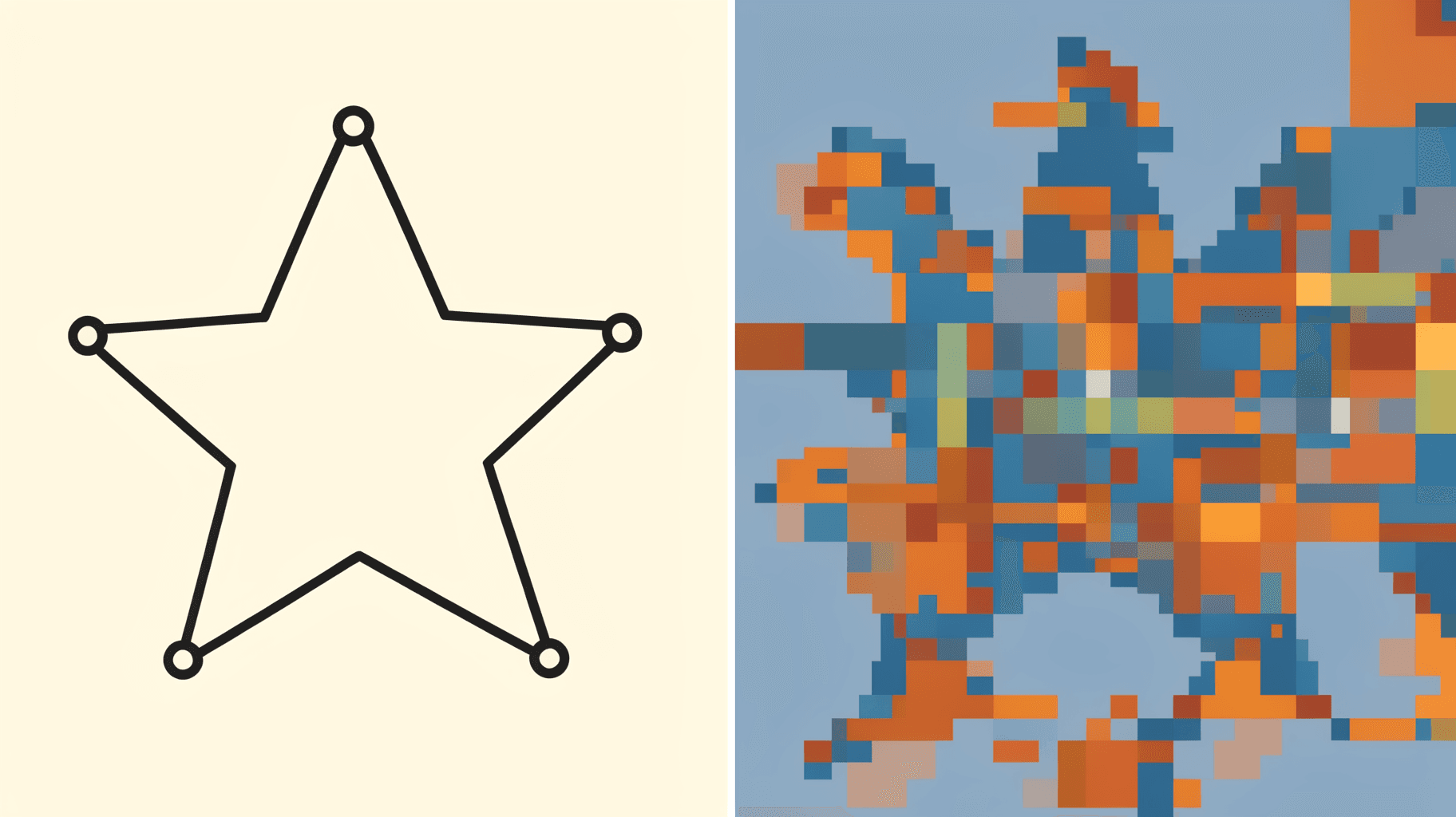
Vector vs Raster: What's the Difference (and Which to Use)
Vector graphics are built from math paths that scale to any size; raster images are grids of pixels that don't. Here's the real difference, plus which one to reach for with logos, photos, and Canva frame shapes.

The Best Canva Apps for Graduation Announcements (2026)
Graduation announcements have to survive being shrunk to a five-by-seven and handled by fifty relatives. Here are the Canva apps that make a cap-shaped photo, a photo-filled headline, and a real four-year collage possible — plus an honest look at what Canva already covers for free.